
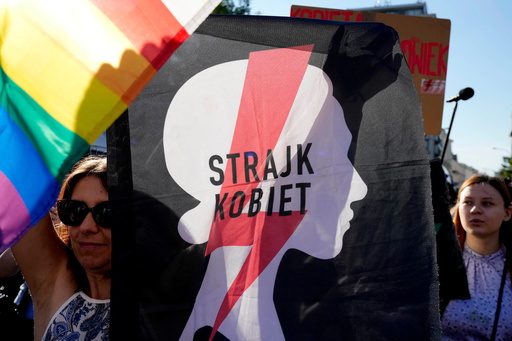
WARSAW, Poland (AP) — Women plan street demonstrations in more than 20 Polish cities and towns Thursday to protest the lack of access to free and legal abortion .
They’re accusing Prime Minister Donald Tusk’s liberal government of failing to fulfill its promise to relax Poland’s strict abortion laws, and protesting even though the parliament passed two bills on Tuesday aimed at easing abortion rules. The measures are likely to be vetoed by the conservative president, Karol Nawrocki .
Passing the draft laws now, a year before the next parliamentary election, is a case of “token gestures” rather than a genuine effort to reform abortion law, said Zofia Marcinek of the Abortion Dream Team, a reproductive rights activist group in Warsaw.
She said the liberal government knew the draft laws stand no chance of withstanding Nawrocki’s veto, and has merely tried to create the impression of taking action because it needs women’s support to win elections next year.
Since 1993, legal abortions have been allowed in Catholic Poland only in cases of severe fetal abnormality, risk to the mother’s life and health, or the pregnancy being a result of rape or incest.
Polish women have been pushing for the legalization of abortion ever since, including in a nationwide wave of demonstrations of women wearing black called “Black Protest,” which began in 2016.
Rather than being liberalized, Poland’s abortion laws were tightened further , banning abortions of fetuses with congenital defects in 2020 under the national-conservative Law and Justice (PiS) government.
Despite the laws, abortions remain common in Poland, an overwhelming majority of which are carried out by women at home using pills obtained from outside the country. Women who undergo abortions, including by taking pills, do not face criminal responsibility under Polish law. But people helping them, including doctors and family, can potentially be prosecuted.
And abortion remains a taboo subject in Poland, which now has one of Europe’s most restrictive abortion laws, with only Malta imposing stricter limits.
Tusk’s pro-European coalition won the 2023 election in part on a promise to liberalize Poland’s abortion laws. But in 2024, Tusk said his government wouldn’t be able to overcome the likely veto of a conservative president. Instead, measures were introduced to prevent hospitals from refusing to perform legal abortions on religious grounds.
“The state will increasingly effectively stand on the side of the woman when she is making dramatic decisions in her life,” Tusk said in 2024 when he announced the measures.
Polish hospitals performed 573 abortions in the first half of 2026, compared to 452 in the whole of 2022 before Tusk came to power, according to data from the national health fund. But activists say tens of thousands of abortions happen yearly outside of hospitals.
Activists organizing Thursday’s protests are claiming the Tusk government has betrayed Polish women — and that Tusk’s claims that women’s access to abortion has improved during his administration have actually complicated getting care for some women.
“The government’s promises act as a type of disinformation,” Marcinek told the AP. “Women getting pregnant hear the prime minister say that everything is ok, that there is access to abortion, and then they end up in the hospital and see that is not the case. So they come to us when it’s very late and very complicated and expensive to help them.”
Meanwhile, international donors are less interested in supporting Polish women’s rights because they mistakenly believe things have improved, Marcinek said.
In 2025, the Abortion Dream Team opened an “ abortion clinic ” across from the parliament building in Warsaw where women can get information about their options, or even take their abortion pills in the company of supporting activists.
This September, the activists also launched a parcel locker dispensing abortion pills at the same location, nicknamed “Abortomat.”
The dispenser is operated by the international feminist non-profit Women Help Women. It enables women needing abortions to get the pills the next day, rather than wait for up to two weeks for home delivery, Marcinek said.
“There are also people who cannot safely order such pills at their own address, for example because of an unsupportive family or abusive partner,” she said. “These women can get a pin number and pick up the pills in the machine the next day.”
“In Poland, assisting with an abortion is a criminal offence. Even passing the pills from hand to hand can be considered a crime,” the Abortion Dream Team wrote in a statement. “That’s why we’re hacking the Criminal Code and bringing abortion into the 21st century.”


